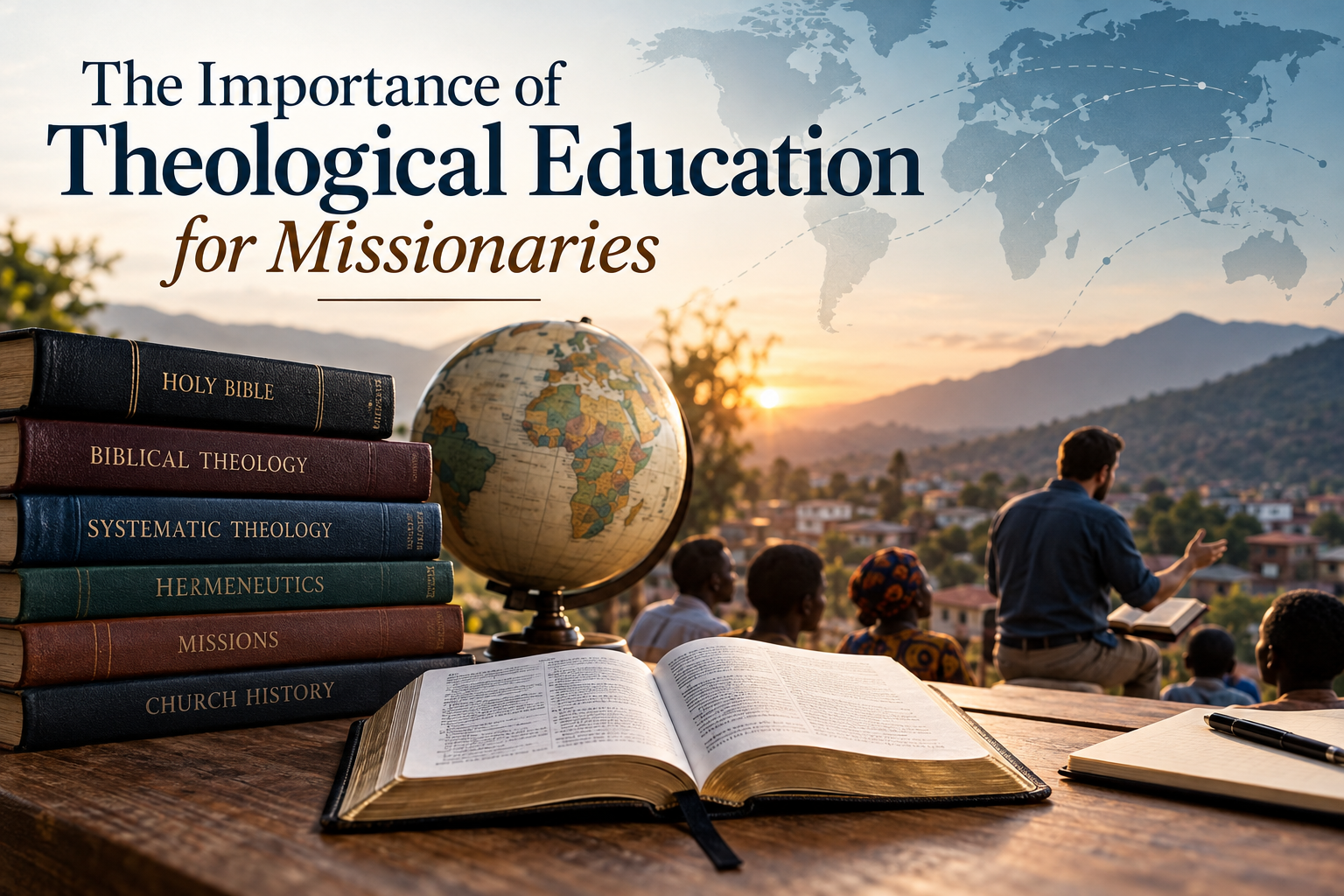
The missionary calling is fundamentally theological because missionaries are entrusted with proclaiming the gospel of Jesus Christ, making disciples, establishing churches, and equipping believers for faithful Christian living. These responsibilities require more than enthusiasm, cultural sensitivity, or a willingness to serve. They demand a sound understanding of Scripture, Christian doctrine, and the mission of God. Consequently, theological education should not be considered an optional component of missionary preparation but an essential foundation for effective and sustainable ministry. Although missionaries serve in diverse cultural contexts, their fundamental responsibility remains the same: to communicate God’s Word faithfully and equip others to do likewise. Without adequate theological preparation, missionaries risk communicating an incomplete gospel, perpetuating doctrinal errors, and establishing ministries that lack the biblical foundations necessary for long-term spiritual maturity.
A missionary’s primary responsibility is to communicate the gospel faithfully, which requires an accurate understanding of the biblical message. Missionaries must understand not only individual biblical passages but also Scripture’s overarching narrative, including creation, the fall, redemption, and restoration. The apostle Paul emphasized the importance of handling Scripture accurately when he instructed Timothy to present himself as a worker who correctly handles the word of truth (2 Timothy 2:15). Theological education equips missionaries with the tools needed for responsible biblical interpretation. Studies in biblical hermeneutics, Old and New Testament theology, and systematic theology help missionaries distinguish Scripture’s intended meaning from interpretations shaped by personal assumptions or cultural traditions. This preparation becomes particularly important in cross-cultural ministry, where missionaries encounter worldviews and religious practices that differ significantly from their own. Without a strong biblical foundation, they may struggle to distinguish between legitimate cultural expressions of Christianity and beliefs that contradict biblical teaching.
Throughout church history, doctrinal confusion has threatened the spiritual health of Christian communities, and the New Testament repeatedly emphasizes church leaders’ responsibility to preserve sound doctrine. Paul instructed Titus that an elder must hold firmly to the trustworthy message so he can encourage others through sound doctrine and refute those who oppose it (Titus 1:9). Missionaries frequently serve in environments where access to theological resources and qualified teachers is limited. Consequently, their understanding of Christian doctrine may significantly influence the theological development of entire congregations. For example, an inadequate understanding of salvation may create confusion about grace, faith, and works, while insufficient knowledge of ecclesiology may lead to churches organized around missionary personalities rather than biblical principles. Although theological education does not guarantee doctrinal faithfulness, disciplined theological study provides important safeguards by teaching missionaries to evaluate beliefs and practices against the authority of Scripture.
Effective missionary service also requires communicating biblical truth within cultural settings that may differ substantially from one’s own. The challenge involves more than translating theological terminology into another language because missionaries must understand how people interpret reality, establish moral values, and respond to religious claims. Paul’s ministry in Athens provides an important example of this responsibility (Acts 17:16–34). Paul demonstrated awareness of his audience’s religious and philosophical environment while maintaining the essential truths of biblical revelation. Theological education helps missionaries develop the discernment needed for responsible contextualization, communicating biblical truth in culturally understandable ways without compromising its theological content. This requires distinguishing between biblical principles and cultural expressions. For instance, the biblical qualifications for church leadership remain authoritative across cultures, but the practical structures through which leaders are trained and recognized may differ. Without theological discernment, missionaries may impose Western cultural practices as biblical requirements or accommodate local religious assumptions in ways that compromise Christian doctrine.
One of the most significant measures of missionary effectiveness is the development of local Christian leaders capable of sustaining and advancing the ministry. Paul’s instruction to Timothy establishes a pattern of leadership multiplication when he commands Timothy to entrust what he has learned to faithful people who will be able to teach others also (2 Timothy 2:2). This passage identifies a multigenerational process of theological transmission in which Christian leaders communicate biblical truth to others who can continue the teaching ministry. Missionaries lacking adequate theological preparation may successfully organize evangelistic activities or establish congregations yet remain unable to provide the biblical instruction needed to develop mature pastors and church leaders. Theological education equips missionaries to teach doctrine systematically, develop leadership-training materials, evaluate theological understanding, and mentor emerging leaders. Furthermore, missionaries with theological education are better positioned to recognize the importance of providing similar opportunities for indigenous leaders. This does not require reproducing Western seminaries in every cultural context, but rather ensuring local leaders receive accessible, biblically faithful, and contextually appropriate theological preparation. The ultimate objective should be churches capable of teaching, governing, and multiplying without perpetual dependence upon foreign missionaries.
Theological education should never be reduced to acquiring academic knowledge because its ultimate purpose is to cultivate an understanding of God that informs Christian character, spiritual maturity, and faithful ministry. Scripture consistently connects sound teaching with godly living, as Paul instructed Timothy to pay close attention to both his life and his doctrine (1 Timothy 4:16). Missionaries frequently encounter suffering, persecution, ethical dilemmas, interpersonal conflict, and difficult pastoral decisions that require theological reflection grounded in Scripture. A missionary ministering among people experiencing severe suffering, for example, must possess more than compassion. A biblical understanding of suffering, providence, human dignity, and Christian hope provides the theological framework necessary for responsible pastoral care. Nevertheless, theological education must be accompanied by spiritual formation, practical ministry experience, and accountability within the Christian community because academic achievement alone does not establish spiritual maturity. The objective is not merely an educated missionary but a biblically grounded, spiritually mature, and practically competent servant of Christ.
Missionary effectiveness must ultimately be evaluated by lasting spiritual fruit rather than immediate numerical results. A missionary may attract large gatherings or establish numerous programs without developing the theological foundations necessary for long-term congregational health. Jesus’ Great Commission requires making disciples, baptizing them, and teaching them to obey everything Christ commanded (Matthew 28:18–20). The teaching dimension of the Great Commission establishes theological instruction as an essential responsibility of Christian mission. Missionaries equipped to teach Scripture and develop local theological leadership contribute to churches capable of continued growth and multiplication. This understanding should influence how mission organizations recruit, prepare, deploy, and evaluate missionaries, ensuring that theological preparation is integrated with cultural training, spiritual formation, and supervised ministry experience.
Recognizing the importance of theological education does not require every missionary to complete a traditional seminary degree before entering missionary service. Instead, evaluate theological preparation in light of the biblical knowledge, theological understanding, and ministry competencies a missionary must have to fulfill their responsibilities. Traditional seminary education is one means of providing this preparation, but it is not the only legitimate approach. Modular theological education, competency-based programs, and intentional mentoring relationships can also provide rigorous and meaningful theological formation when grounded in Scripture and held to appropriate standards of theological understanding and ministerial competence. Ultimately, the determining factor should not be an academic credential but whether a missionary is adequately equipped, both theologically and practically, for the ministry responsibilities entrusted to them.
Theological education is essential to faithful missionary service because Christian mission is inseparable from biblical truth. Missionaries are called not merely to organize ministry activities but to proclaim the gospel, make disciples, establish healthy churches, and equip future generations of Christian leaders. Although theological education alone cannot guarantee missionary effectiveness, its absence creates significant vulnerabilities for missionaries and the communities they serve. Mission organizations must therefore resist prioritizing enthusiasm, availability, or practical skills over theological preparation. Ultimately, theological education should be understood not as an academic obstacle delaying missionary deployment but as an investment in the faithfulness, effectiveness, and sustainability of the church’s global mission.